
Last Updated on by Amninder Singh
Industry: local services (health, finance, property) · Market: Pathankot in Punjab, and Faridabad, Gurugram and Haryana near Delhi · Channel: Facebook and Instagram ads to calls, forms and WhatsApp · Period: February 2024 to July 2026 · Client names withheld
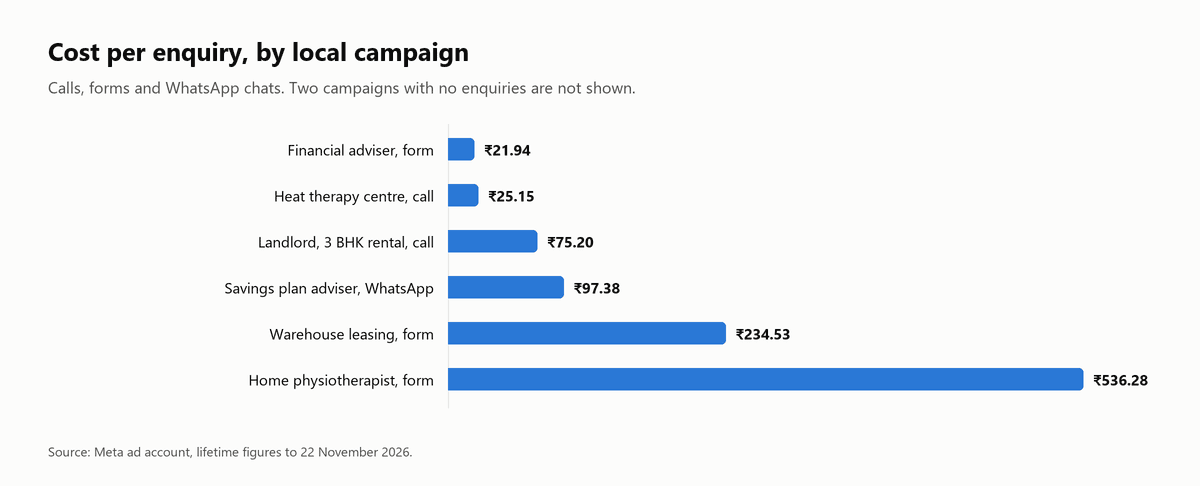
Most local businesses that ask me about Meta ads want to try it with a few hundred rupees before they commit. This post collects eight such tests from two ad accounts. The total spend was ₹5,485 and Meta recorded 48 enquiries. Five campaigns produced enquiries at a price the owner could work with. Three produced one enquiry between them.
All eight campaigns
| Business | Area | Enquiry type | Spend | Enquiries | Cost per enquiry |
|---|---|---|---|---|---|
| Financial adviser, ex-servicemen | Pathankot | Instant form | ₹263 | 12 | ₹21.94 |
| Heat therapy centre | Pathankot, 40 km | Phone call | ₹352 | 14 | ₹25.15 |
| Landlord, 3 BHK floor at ₹55,000 a month | Gurugram, four pin codes | Phone call | ₹526 | 7 | ₹75.20 |
| Savings plan adviser | Pathankot, 10 miles | WhatsApp chat | ₹487 | 5 | ₹97.38 |
| Warehouse leasing, 12,000 to 15,000 sq ft | Haryana, 28 pin codes | Instant form | ₹2,111 | 9 | ₹234.53 |
| Home physiotherapist | Faridabad | Instant form | ₹536 | 1 | ₹536.28 |
| Home physiotherapist | Faridabad | Phone call | ₹942 | 0 recorded | n/a |
| Family protection plan | Pathankot, married, 30 to 45 | Instant form | ₹267 | 0 | n/a |
| Total | ₹5,485 | 48 | ₹114.26 |
What worked
1. A named audience in a small town: 12 leads for ₹263
The financial adviser’s campaign spoke to one group, ex-servicemen in Pathankot, which is an army town. The ad and the form were both written for them. 2.02% of people who saw it clicked and 12 filled in the form at ₹21.94 each, with impressions costing ₹49.79 per thousand.
The same account ran two more finance campaigns in the same town a few weeks later with general messages about savings and family responsibility. They cost ₹97.38 per chat and ₹267 for no leads. The town and the product were the same. The difference was an ad that named who it was for.
2. Calls for a service older people want: ₹25.15 each
The therapy centre’s ad had one line about using heat therapy to manage long-term illness and a Call Now button. It ran on mobile only, 40 km around Pathankot, with Meta steered towards ages 50 to 65. ₹352 reached 18,462 people at ₹16.92 per thousand impressions and 14 of them called from the ad.
A phone call suits this audience. Someone of 60 with joint pain will ring a number before they fill in a form.
3. Pin code targeting for property
The landlord’s ad showed the rent in the first line, ₹55,000 a month, and targeted four Gurugram pin codes. Seven people called at ₹75.20. A stated price turns away people who cannot afford it, so seven calls here are worth more than seventy from an ad that hides the rent. One tenant covers the ₹526 many times over.
4. ₹234 a lead can be cheap
The warehouse campaign has the highest cost per lead among the campaigns that worked, and I still count it as a success. It asked for businesses that need 12,000 to 15,000 square feet, aimed at men in 28 industrial pin codes across Haryana. Nine leads came in for ₹2,111. A lease of that size runs for years. If one of the nine signs, the ad cost is a rounding error.
What did not work
1. The physiotherapist: 60,127 impressions and no recorded calls
This is the same kind of clinic as in my Google Ads physiotherapy case study, and Meta went no better. The call campaign showed a video to 47,661 people across ten Faridabad localities for ₹942. People reacted to it 3,527 times and 117 clicked. Meta recorded no calls. A form campaign beside it spent ₹536 for one lead, at ₹234.70 per thousand impressions.
The average watch time on the call video was one second. People scrolled past before the offer appeared, and a video that is not watched cannot produce a call. The engagement count suggests Meta found people who tap and react, and they are a different group from people who need a physiotherapist this week.
Physiotherapy is also a need that arrives suddenly. Someone with a back injury searches for help that day. Meta shows ads to people who were not looking, so most of the 47,661 had no reason to call.
2. Layered targeting in a small town: ₹97.38 per chat
The savings plan campaign stacked conditions: women, 25 to 55, within 10 miles of Pathankot plus seven named neighbourhoods, married, interested in personal finance, and working as a teacher, doctor, accountant, government employee or in the Air Force. Meta’s audience expansion was switched off.
Each condition removed people until very few were left, and impressions cost ₹64 per thousand. Five chats came from 7,495 impressions. In a town this size, the location alone is already a narrow audience.
3. A form campaign with no leads
The family protection campaign spent ₹267, reached 1,796 married people aged 30 to 45 and got 13 clicks and no forms. At ₹100.66 per thousand impressions and a 0.75% click rate, both the audience and the ad were weak. It was right to stop it early.
4. None of these tests ran long enough to be sure
The best campaign here has 12 results. Meta’s own guidance is that an ad set needs around 50 results in a week before delivery settles. Every number in this post is a first signal. The winners deserve a second, larger test before anyone calls them proven.
What I learnt
- Name the group in the ad. Ex-servicemen answered an ad written for ex-servicemen at ₹21.94. General finance messages in the same town cost four times more or failed.
- Pick the enquiry type the customer would choose. Calls for older patients and for tenants, forms for people comparing financial products, WhatsApp for younger audiences.
- Put the price or the size in the first line when the product is expensive. It filters before the click, which is the cheapest place to filter.
- In a small town, target the place and let the ad choose the people. Stacked interests and job titles left too few people to deliver to.
- Judge cost per lead against what a customer is worth. ₹234 for a warehouse lead is better business than ₹25 for most things.
- Urgent needs belong on search. Physiotherapy failed on Meta and struggled on Google for the same clinic type, and the Google clicks at least came from people who were looking.
- Watch time is an early warning. A one-second average means the first frame has to change before any more money is spent.
What I would do next for each
- Financial adviser: rerun the ex-servicemen campaign at ₹200 a day for two weeks, then write the same kind of ad for teachers and for government staff, one group per ad.
- Therapy centre: keep the call campaign running during opening hours only, and ask every caller how they heard about the centre.
- Landlord and warehouse firm: same structure for every new listing, with price or area in the first line.
- Physiotherapist: stop cold Meta campaigns. Use Google Search with call tracking, and use Meta only to retarget website visitors.
- Savings and family plans: drop the layers, target the town, and test three ads that each name one kind of customer.
Figures are from two Meta ad accounts and were not adjusted. Enquiries are calls, forms and chats as recorded by Meta.
More Meta Ads case studies
- Spoken English classes, India: 1,120 leads at ₹5.98 each
- Video editing institute, Punjab: 5,787 WhatsApp enquiries
- Hebrew teacher, Israel, UK and US: leads from $0.97
- Bill comparison site, UK: 395,179 people reached for ₹6,378
- Restaurant, Punjab: a reel watched 8,742 times for ₹372
- Mental health counselling: leads from $2.09 each
If you want to learn to run and read campaigns like these, see my Meta Ads course. If you want them run for you, see my Meta Ads agency page. All of my Meta Ads case studies are on the Meta Ads case studies page. For enquiries across Google and Meta together, see my lead generation service. You can look up any advertiser’s live ads in the Meta Ad Library.