
Last Updated on by Amninder Singh
Industry: private language teaching (spoken Hebrew, small groups and 1:1) · Market: Israel, United Kingdom, United States · Channel: Facebook and Instagram ads · Period: November 2024 to July 2026 · Client name withheld
A Hebrew teacher works alone and teaches adults who have moved to Israel or have family there. The budget was small, about $1,060 across everything in this post, so every campaign was a test. That makes the account useful to read. The same teacher and the same lessons produced a lead for $0.97 in one campaign and $21.94 in another, and the reasons are visible in the settings.
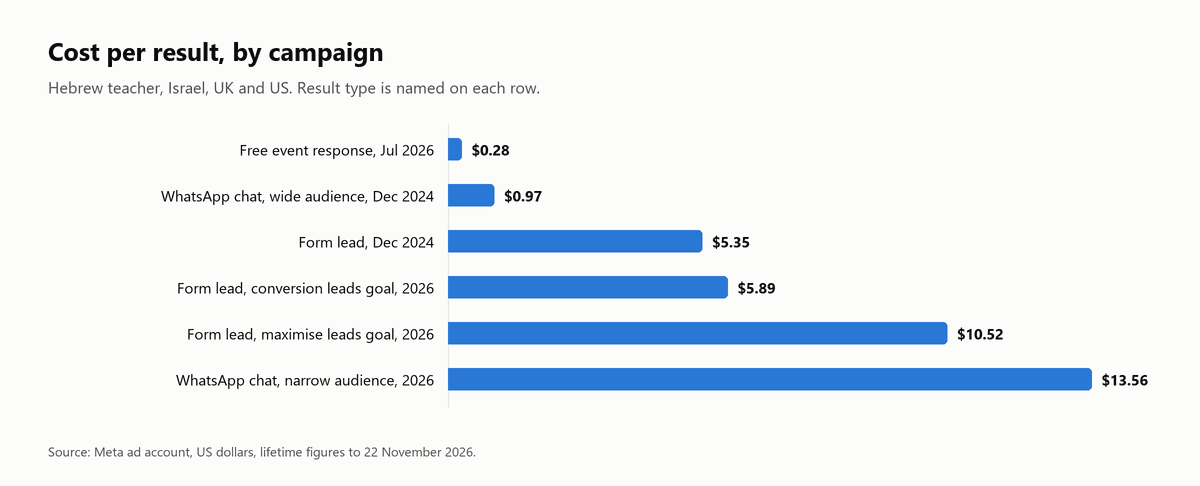
Every campaign in one table
| Campaign | When | Spend | Result | Cost per result |
|---|---|---|---|---|
| Landing page, optimised for page views | Nov 2024 | $82.42 | 68 landing page views, no leads recorded | n/a |
| Instant form | Dec 2024 | $155.24 | 29 leads | $5.35 |
| WhatsApp chats, wide audience | Dec 2024 | $208.73 | 215 chats started | $0.97 |
| Instant form, six ad angles, “maximise leads” | May 2026 | $199.87 | 19 leads | $10.52 |
| Instant form, same angles, “conversion leads” | May to June 2026 | $282.64 | 48 leads | $5.89 |
| Landing page, optimised for website leads | June 2026 | $15.15 | 9 landing page views, no leads recorded | n/a |
| WhatsApp chats, narrow audience | June to July 2026 | $67.81 | 5 chats started | $13.56 |
| Free online event | July 2026 | $47.56 | 170 event responses | $0.28 |
What worked
1. WhatsApp to a wide, interested audience: 215 chats at $0.97
In December 2024 one teaching video ran with a WhatsApp button. The audience was the United States, Australia and Tel Aviv, ages 18 to 65, with interests in Modern Hebrew, the Hebrew language, Jewish studies and Israel. The text was a single line: learn to speak conversational Hebrew from the first lesson.
The campaign reached 47,176 accounts for $208.73. Impressions cost $3.26 per thousand, which is very low for these countries, and 2.44% of people who saw the ad clicked. The audience was large enough for Meta to pick the cheapest people in it who were likely to message.
2. Six angles tested, one clear winner
In May 2026 I set up six ad sets, each with one ad built on a different idea, all aimed at women aged 25 to 65 in four towns north of Tel Aviv with many English-speaking immigrants, plus England. Each ad had its own ad set so that every idea got a fair share of the budget.
| Angle | Format | Spend (both rounds) | Leads | Cost per lead |
|---|---|---|---|---|
| “Complete beginner? Start from zero” | Video with background music | $194.40 | 30 | $6.48 |
| “Ditch confusing apps”, fast video with no pauses | Video | $129.90 | 19 | $6.84 |
| Common Hebrew mistakes | Images | $60.73 | 8 | $7.59 |
| “Do you freeze when you speak?” | Video | $36.55 | 3 | $12.18 |
| “Not clicking” hook with music | Video | $34.53 | 4 | $8.63 |
| “I have been learning Hebrew” | Video | $22.66 | 2 | $11.33 |
The beginner angle won. It tells a nervous person that no experience is needed, that the group is small, and that the first lesson is free. The “do you freeze” angle speaks to someone who has already studied and is stuck. In this audience there were more people at zero than people who were stuck.
3. Changing one setting halved the cost per lead
The first round of the six-angle test was set to maximise the number of leads. It spent $199.87 for 19 leads at $10.52. A week later the same ads and audience ran again with the performance goal changed to conversion leads, which asks Meta to look for people likely to go further than the form.
| Performance goal | Spend | Leads | Cost per lead | Cost per 1,000 impressions |
|---|---|---|---|---|
| Maximise number of leads | $199.87 | 19 | $10.52 | $20.25 |
| Maximise conversion leads | $282.64 | 48 | $5.89 | $12.80 |
The winning beginner ad went from $13.79 per lead in the first round to $4.65 in the second. I expected the stricter goal to cost more per lead, and it cost less, mostly because impressions were about 37% cheaper in the second round. The second round also had a week of data from the first, so some of the gain is the account learning. I would not promise this result to another client, and I would run the same comparison again.
4. A free event: 170 responses for $47.56
In July 2026 a Facebook event was promoted: one free online session to learn spoken Hebrew, “even if nothing else has worked”. The audience was women 25 to 65 in the US, the UK and two areas of Israel, with an interest in Israel or a history of having lived there. It ran on Facebook only.
The click rate was 8.61%, the highest in the account, and 170 people responded to the event at $0.28 each. Saying “interested” on an event is a small step. It also puts a reminder in the person’s Facebook calendar, which a form does not.
5. The first instant form campaign set the benchmark
In December 2024 a form campaign aimed at the US and three Jewish neighbourhoods in South Africa brought 29 leads at $5.35 with a 6.63% click rate. Every form campaign after it was measured against that number.
What did not work
1. Three landing page campaigns, no leads recorded
The November 2024 campaign sent 68 people to the website for $82.42. It was optimised for content views, so Meta looked for people who load pages, and no lead was recorded. A June 2026 landing page campaign was stopped after $15.15 and 9 page views. With budgets this small a website adds a step and a tracking setup that the forms and WhatsApp do not need.
2. WhatsApp to a narrow audience: $13.56 per chat
In June 2026 WhatsApp ads ran again, this time to the same narrow audience as the form test: women in four Israeli towns and England. Two campaigns spent $67.81 and started 5 chats. The ad was a text post with a trial class link.
| WhatsApp campaign | Audience | Cost per 1,000 impressions | Chats | Cost per chat |
|---|---|---|---|---|
| December 2024 | US, Australia, Tel Aviv, Hebrew interests, video ad | $3.26 | 215 | $0.97 |
| June to July 2026 | Four Israeli towns and England, women 25 to 65, text ad | $10.33 | 5 | $13.56 |
Impressions cost three times more and the ad was plain text where the earlier one was the teacher on video. Both changes pushed in the same direction.
3. Some angles never got a fair test
The “I have been learning Hebrew” ad received $22.66 in total and the “do you freeze” ad $36.55. With leads costing $6 to $10, that is two or three leads each, too few to judge. Splitting about $480 across six ad sets left the smaller ones starved. Three angles would have given a clearer answer for the same money.
4. The cheap leads and the right leads may be different people
The $0.97 chats came from the US, Australia and Tel Aviv. The $5.89 leads came from towns where the teacher’s ideal students live. A chat from another time zone is worth less to a teacher with fixed class hours. The account does not record who booked a trial, so this question is still open.
What I learnt
- Audience size sets the price before the ad does. The wide audience paid $3.26 per thousand impressions. The narrow one paid $10 to $20. On a small budget, start wider than feels comfortable and let the form questions do the filtering.
- Speak to the true beginner. “Start from zero, no experience needed” beat every angle about being stuck or frustrated.
- Test the performance goal as well as the ad. Conversion leads cost $5.89 against $10.52 for maximise leads on the same ads.
- Keep the lead inside the app when the budget is under $500. Forms, WhatsApp and events all produced results. All three website campaigns produced none that were recorded.
- The teacher on video beats text. Every winning ad showed the teacher teaching.
- A free event is a cheap first step. At $0.28 a response it is worth running before every new group starts.
- Fewer ad sets on a small budget. Six angles on $480 was too many.
What I would run next
- One instant form campaign on the conversion leads goal with the top two videos, both in a single ad set, so the budget is not split.
- One WhatsApp campaign to a wider English-speaking audience in Israel and the UK, using the beginner video.
- A free event two weeks before each new group, promoted to the people who filled in a form and did not book.
- A sheet where the teacher marks each lead: replied, took the trial, paid. After 100 leads the cost per paying student will show which route to keep.
Figures are from the Meta ad account, in US dollars, and were not adjusted. Lead counts by angle add both test rounds together.
More Meta Ads case studies
- Spoken English classes, India: 1,120 leads at ₹5.98 each
- Video editing institute, Punjab: 5,787 WhatsApp enquiries
- Bill comparison site, UK: 395,179 people reached for ₹6,378
- Restaurant, Punjab: a reel watched 8,742 times for ₹372
- Local businesses, Punjab and Delhi NCR: eight campaigns under ₹2,200 each
- Mental health counselling: leads from $2.09 each
If you want to learn to run and read campaigns like these, see my Meta Ads course. If you want them run for you, see my Meta Ads agency page, or the pages for US and UK advertisers. All of my Meta Ads case studies are on the Meta Ads case studies page. For enquiries across Google and Meta together, see my lead generation service. You can look up any advertiser’s live ads in the Meta Ad Library.