
Last Updated on by Amninder Singh
Industry: bill comparison website (energy, broadband, mobile) · Market: United Kingdom · Channel: Facebook, Instagram and Audience Network ads · Period: 27 October to mid November 2026 · Client name withheld
A new UK comparison site wanted people to know it exists. Over three weeks the account ran one awareness campaign, one traffic campaign and one campaign for Facebook page likes, all aimed at the UK and paid for in rupees. The total was ₹9,708. The awareness campaign reached 395,179 accounts, which looks like the win. The detail inside it is more useful than the headline, because the three ad sets in that campaign paid wildly different prices for the same country.
The numbers
| Campaign and ad set | Goal | Spend | Impressions | Reach | Cost per 1,000 impressions | Link clicks |
|---|---|---|---|---|---|---|
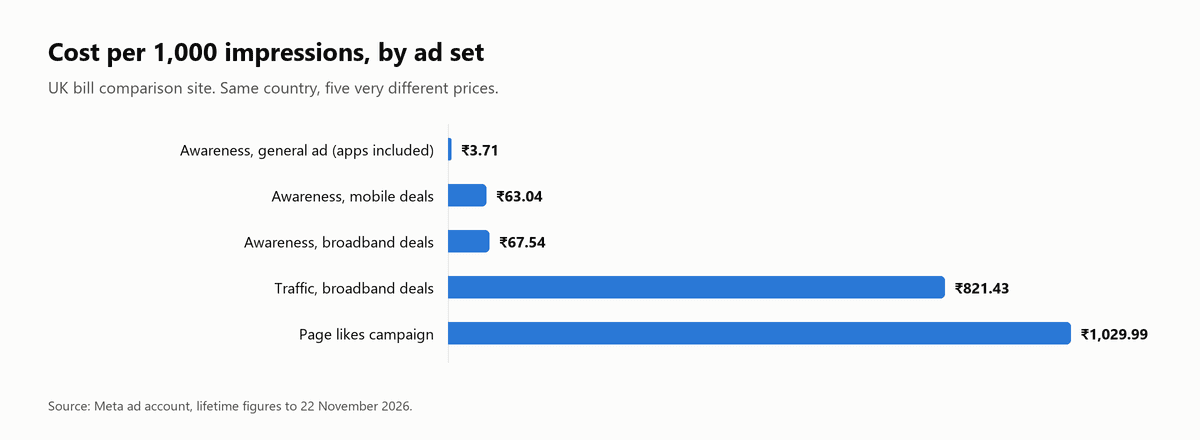
| Awareness: all bills, general ad | Reach | ₹1,237 | 333,243 | 327,569 | ₹3.71 | 237 |
| Awareness: broadband deals | Reach | ₹2,886 | 42,729 | 40,373 | ₹67.54 | 54 |
| Awareness: mobile deals | Reach | ₹2,255 | 35,772 | 34,181 | ₹63.04 | 28 |
| Traffic: broadband deals | Landing page views | ₹2,137 | 2,601 | 2,132 | ₹821.43 | 103 (98 page views) |
| Page likes | Profile and page visits | ₹1,194 | 1,159 | 1,049 | ₹1,029.99 | 74 (92 visits, 1 like) |
What worked
1. Reach was cheap, even in the UK
The awareness campaign spent ₹6,378 and put an ad in front of 395,179 UK accounts once each (average frequency 1.04). That is about ₹16 per thousand people. For a brand nobody has heard of, a first impression at that price is a fair start, and the campaign did what a reach goal is built to do.
2. The traffic campaign found people who read the page
The traffic ad said “Save on broadband bills” and asked for one thing: enter your postcode to get started. It was optimised for landing page views, so Meta looked for people who wait for a page to load.
4.11% of the people who saw it clicked, and 98 of the 103 clicks became a loaded page. That is 95%, the best click-to-page rate in any account I reviewed this year. Each visit cost ₹21.80, which is roughly 20 pence.
3. A specific ad beat a general one on clicks
| Ad | Text | Click rate |
|---|---|---|
| Awareness, general | “For best deals, visit” plus the site name | 0.10% |
| Awareness, broadband | “Compare broadband, phone and TV” | 0.13% |
| Traffic, broadband | “Save on broadband bills. Simply enter your postcode to get started” | 4.11% |
Part of that gap comes from the goal, since a reach campaign does not look for clickers. Part comes from the words. The traffic ad names the saving and the first step. The awareness ads name the website.
What did not work
1. The ₹3.71 ad set is too cheap to trust
Two awareness ad sets paid ₹63 to ₹68 per thousand impressions. The third paid ₹3.71, about 18 times less, and took 81% of all the impressions in the campaign. All three targeted the UK.
The settings show one difference that would explain it. The cheap ad set had Audience Network switched on, which places ads inside other companies’ mobile apps and games. The other two did not. App inventory is sold at a fraction of the price of a Facebook or Instagram feed, and Meta’s reach goal buys the cheapest impressions it can find.
An impression inside a mobile game is worth less than one in a feed. People tap those ads by accident, and the 237 clicks from this ad set were never checked against page views, so nobody knows how many arrived on the site. I would treat the 327,569 reach figure as a number that needs the placement report beside it before it goes in front of a client.
2. The page likes campaign bought visits, and got one like
The campaign was named for a target of 100 page likes. The performance goal chosen was profile and page visits, and the button on the ad opened the Instagram profile. Meta delivered what was asked: 92 visits at ₹12.98 each. One person liked the page.
At ₹1,030 per thousand impressions this was also the most expensive delivery in the account. A like campaign needs the page likes goal and a Like Page button. Even then, likes on a comparison site’s page do little for the business, and I would have spent this ₹1,194 on the traffic campaign.
3. Nothing after the click was measured
A comparison site earns when a visitor compares and switches. The ad account shows no lead, no postcode search and no outbound click as a conversion. Without one of those events, 98 good visits cannot be valued, and Meta cannot be asked to find more people like the ones who searched.
4. Traffic in the UK is expensive per impression
₹821 per thousand impressions is high. It is the price of asking Meta for the small group of UK users who click and stay, from an account with no history in that market. The cost per visit was still reasonable. A site paid per switch needs to know its income per visitor before it can say whether 20 pence is cheap.
What I learnt
- Read reach numbers by placement. A reach campaign with Audience Network on will fill up with app impressions. For a first brand campaign I would limit placements to Facebook and Instagram feeds, stories and reels, and accept a higher price.
- The goal you pick is the result you get. Reach bought reach, landing page views bought page views, and profile visits bought profile visits. The like campaign failed at the settings screen.
- Put the first step in the ad. “Enter your postcode” tells the reader what happens next and how little effort it takes.
- Set up one conversion event before any spend. For this site that is the postcode search. It turns a traffic campaign into a campaign that can be judged.
- Cheap impressions and useful visits are different purchases. The awareness campaign paid ₹16 per thousand people and ₹20 per click. The traffic campaign paid ₹821 per thousand impressions and ₹21.80 per confirmed visit. For nearly the same money per visitor, the traffic campaign’s visitors are known to have arrived.
What I would run next
- A postcode search event on the site, tested and visible in Events Manager.
- The broadband traffic ad again, now optimised for that event, with separate ads for energy and mobile.
- A small reach campaign on feeds and reels only, shown to the same people about three times across two weeks, since a single impression is soon forgotten.
- Retargeting for visitors who loaded the page and did not search.
- No page like campaigns.
Figures are from the Meta ad account and were not adjusted. The account is billed in Indian rupees. The pence figure uses an approximate exchange rate.
More Meta Ads case studies
- Spoken English classes, India: 1,120 leads at ₹5.98 each
- Video editing institute, Punjab: 5,787 WhatsApp enquiries
- Hebrew teacher, Israel, UK and US: leads from $0.97
- Restaurant, Punjab: a reel watched 8,742 times for ₹372
- Local businesses, Punjab and Delhi NCR: eight campaigns under ₹2,200 each
- Mental health counselling: leads from $2.09 each
- Google Ads: a 5-week search test for a UK broadband comparison site
If you want to learn to run and read campaigns like these, see my Meta Ads course. If you want them run for you, see my Meta Ads agency page. All of my Meta Ads case studies are on the Meta Ads case studies page. You can look up any advertiser’s live ads in the Meta Ad Library.