
Last Updated on by Amninder Singh
Industry: online spoken English classes · Market: Maharashtra first, then the rest of India · Channel: Facebook and Instagram ads · Period: August 2025 to June 2026 · Client name withheld
A teacher runs live spoken English classes for adults who understand English and are afraid to speak it. Over ten months the account tried four different ways of turning an ad view into a contact: a landing page form, a free WhatsApp group, a low-priced ebook, and Meta’s own instant form. Each route had a clear winner and a clear failure. This post shows all of them with the real costs.
Who ran what: this is my review of the whole account. Several people worked in it. The WhatsApp group campaigns of April and May 2026 and the landing page campaigns of November 2025 were set up by other marketers on the client’s side, and I say so here because their results are among the best in the account. The analysis, the lessons and the next steps are mine.
The four routes side by side
| Route | When | Spend | Result | Cost per result |
|---|---|---|---|---|
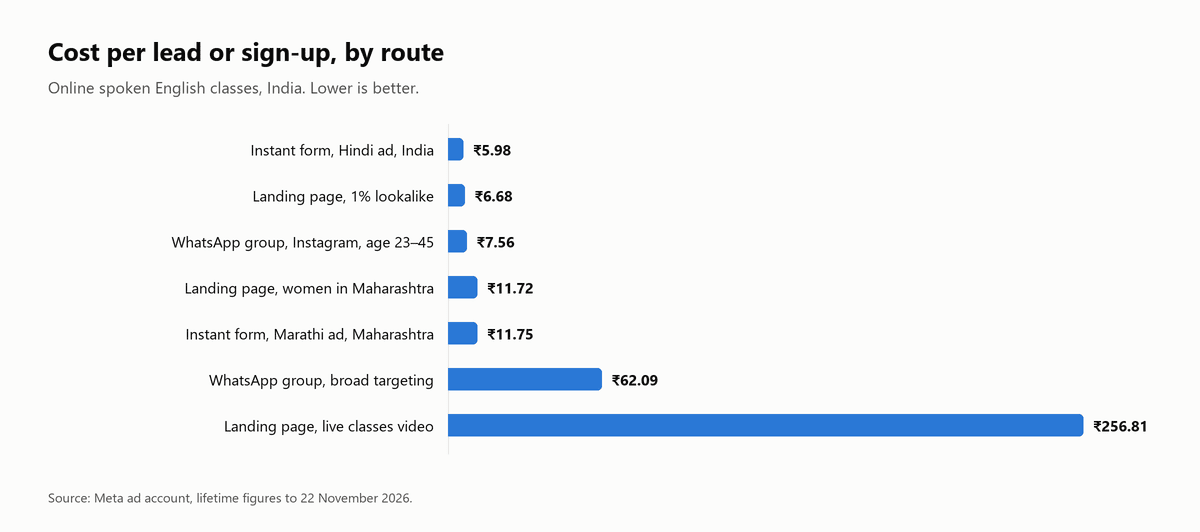
| Landing page form, 1% lookalike audience | Aug 2025 | ₹1,489 | 223 website leads | ₹6.68 |
| Landing page form, women in Maharashtra, three campaigns | Nov 2025 | ₹7,010 | 598 website leads | ₹11.72 |
| Ebook sales, eight largest campaigns | Dec 2025 to Mar 2026 | ₹16,884 | 255 purchases worth ₹29,054 | ₹66.21 (return 1.72x) |
| Free WhatsApp group, broad targeting | Mar 2026 | ₹2,794 | 45 sign-ups | ₹62.09 |
| Free WhatsApp group, Instagram only, age 23 to 45 | Apr to May 2026 | ₹7,041 | 931 sign-ups | ₹7.56 |
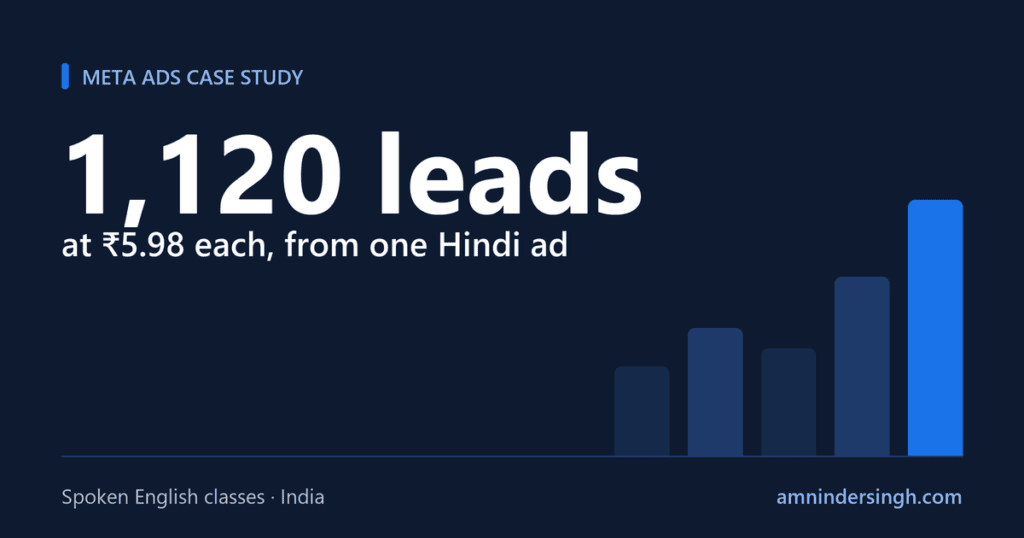
| Instant form, Hindi ad, India outside Maharashtra | May 2026 | ₹6,693 | 1,120 leads | ₹5.98 |
| Instant form, Marathi ad, Maharashtra | June 2026 | ₹2,491 | 212 leads | ₹11.75 |
| Landing page, “live classes” video | June 2026 | ₹1,284 | 5 website leads | ₹256.81 |
What worked
1. The instant form with a fear-based Hindi ad: 1,120 leads at ₹5.98
The best campaign in the account was also the simplest. One ad set, all of India except Maharashtra, ages 18 to 65, with language-learning interests given to Meta as a suggestion and Advantage+ audience left on. The form opened inside Facebook and Instagram, so nobody had to wait for a website to load.
One ad did almost all the work. It opened by asking, in Hindi, whether the viewer is scared of speaking English, then listed the exact thoughts that stop people: what will others think, what if I say it wrong. It closed with four places the skill is used: interviews, the job, daily conversation and phone calls.
| Ad | Spend | Impressions | CTR | CPM | Leads | Cost per lead |
|---|---|---|---|---|---|---|
| Hindi, “are you scared of speaking English?” | ₹6,118 | 224,124 | 1.79% | ₹27.30 | 1,032 | ₹5.93 |
The campaign was set to optimise for conversion leads, which asks Meta to look for people likely to go further than filling in a form. Even with that stricter goal the cost stayed under ₹6.
2. Narrowing the WhatsApp group campaign cut the cost from ₹62 to ₹7.56
In March 2026 three campaigns sent people to a page where they could join a free WhatsApp group for daily live classes. Targeting was wide open: all of Maharashtra, 18 to 65, every placement. Together they spent ₹2,794 for 45 sign-ups.
In April two other marketers on the client’s side ran the same offer again with three changes: Instagram placements only, ages 23 to 45, and a Marathi video that said plainly that the classes are free and happen every day on WhatsApp. Four campaigns spent ₹7,041 and brought 931 sign-ups. The cost per thousand impressions dropped from about ₹38 to about ₹19, and roughly three out of four clicks turned into a loaded page.
| Campaign | Spend | Landing page views | Sign-ups | Cost per sign-up |
|---|---|---|---|---|
| April, started 17th (a) | ₹2,084 | 659 | 249 | ₹8.37 |
| April, started 17th (b) | ₹2,002 | 669 | 261 | ₹7.67 |
| April, started 23rd | ₹2,012 | 641 | 298 | ₹6.75 |
| April, started 25th | ₹942 | 288 | 123 | ₹7.66 |
About 40% of the people who reached the page signed up. For a free offer with one button, that is the range I expect when the ad and the page say the same thing.
3. A lookalike audience gave the cheapest landing page leads
The first test, in August 2025, used a 1% lookalike of earlier website leads in Maharashtra. ₹1,489 brought 223 leads at ₹6.68. Three months later, campaigns built by another marketer used the same kind of landing page with open targeting to women in Maharashtra and cost ₹11.72 per lead across 598 leads. Both are good numbers. The lookalike was about 43% cheaper.
4. The ebook paid for its own ads at the start
A beginner ebook with 1,500 daily-use sentences was sold at a low price, with the average order a little over ₹100. The first campaign, in February 2026, spent ₹1,468 and recorded 50 purchases worth ₹6,169. That is ₹29.36 per buyer and a return of 4.2 times the ad spend. Every buyer is also a contact who has already paid once, which matters more to a class business than the ebook income.
What did not work
1. Scaling the ebook by duplicating the campaign
After the first ebook campaign did well, it was copied several times. The copies never matched it.
| Ebook campaign | Spend | Purchases | Cost per purchase | Return on ad spend |
|---|---|---|---|---|
| First campaign (video) | ₹1,468 | 50 | ₹29.36 | 4.20 |
| Copy of the first | ₹884 | 14 | ₹63.18 | 2.02 |
| Second batch, video, Maharashtra | ₹3,025 | 47 | ₹64.37 | 1.78 |
| Second batch, video, all India | ₹4,709 | 70 | ₹67.27 | 1.56 |
| Second batch, image instead of video | ₹2,771 | 19 | ₹145.82 | 0.72 |
| Later copy | ₹866 | 5 | ₹173.26 | 0.69 |
Two things stand out. The image version paid ₹130.70 per thousand impressions against about ₹50 for the videos, and it lost money. And each new copy started learning from zero, so the cost per buyer doubled even when the ad was identical. Across the eight largest ebook campaigns the return was 1.72, which covers the ads but is a long way from 4.2.
2. The campaign with a 33.56% click rate and five leads
In June 2026 a Marathi video for live classes ran to a new landing page. People watched it for 15 seconds on average, far longer than any other ad in the account, and 7,733 clicked through. The page loaded 4,719 times. The account recorded 5 leads.
A click cost about 17 paise, so the fault lies after the click. Either the page did not persuade anyone, or the button that sends people to WhatsApp was not reporting back to Meta. The ad account cannot tell me which. With no leads being reported, Meta had nothing to learn from, and the campaign was stopped at ₹1,284.
3. Duplicating a winning lead form campaign
The Maharashtra instant form campaign produced 212 leads at ₹11.75. A copy launched three days later with a different Marathi ad spent ₹909 for 22 leads at ₹41.33. Same audience, same form, nearly four times the cost.
4. Marathi leads cost twice as much as Hindi leads
The Hindi campaign reached all of India outside Maharashtra and paid ₹27.67 per thousand impressions. The Marathi campaign reached one state and paid ₹39.22. A smaller audience costs more to reach, and the lead cost followed: ₹11.75 against ₹5.98. If the Maharashtra leads are the ones who enrol, the higher price is worth paying, and the business should know it is paying it.
What I learnt
- Remove the website when the offer is simple. In the instant form campaigns, only about one click in four was followed by a landing page view, and leads still cost ₹5.98, because the form never left the app. On mobile data in India, every page load loses people.
- Name the fear in the first line. The ads that opened with “are you scared of speaking English?” beat the ads that opened with course features. The audience already knows what a class is. They needed to see their own worry on the screen.
- Write in the language the student thinks in. Hindi for the national campaign and Marathi for Maharashtra, with English words like “Interview” and “Confidence” left in English the way people say them.
- Do not copy a campaign to scale it. Three separate times in this account a copy cost two to four times more than the original. Raising the budget on the campaign that already works keeps what Meta has learnt.
- Check that a lead is being recorded before spending. One test lead on the new page before launch would have shown whether the 5-lead campaign had a tracking fault or a page fault.
- Video beat image for a ₹100 product. Same text, same audience, and the image version paid more than double per thousand impressions.
- A cheap lead is only half the answer. The account shows what a lead cost and nothing about which route filled the paid classes. The next step for this business is a simple sheet that marks each enrolment with the campaign it came from.
What I would do next
- Run the Hindi instant form campaign as the main source of leads and raise its budget in small steps.
- Keep one WhatsApp group campaign for Maharashtra on Instagram, ages 23 to 45, since it already works at ₹7.56.
- Build a lookalike audience from ebook buyers and from students who paid for classes, and test it against open targeting.
- Fix the tracking on the live classes page and rerun that video, because a 15-second average watch time is too good to throw away.
- Follow up every lead within the hour on WhatsApp, and record who enrols.
Figures are from the Meta ad account and were not adjusted. Totals for the ebook cover the eight largest campaigns, not every campaign in the account.
More Meta Ads case studies
- Video editing institute, Punjab: 5,787 WhatsApp enquiries
- Hebrew teacher, Israel, UK and US: leads from $0.97
- Bill comparison site, UK: 395,179 people reached for ₹6,378
- Restaurant, Punjab: a reel watched 8,742 times for ₹372
- Local businesses, Punjab and Delhi NCR: eight campaigns under ₹2,200 each
- Mental health counselling: leads from $2.09 each
If you want to learn to run and read campaigns like these, see my Meta Ads course. If you want them run for you, see my Meta Ads agency page. All of my Meta Ads case studies are on the Meta Ads case studies page. For enquiries across Google and Meta together, see my lead generation service. You can look up any advertiser’s live ads in the Meta Ad Library.