
Last Updated on by Amninder Singh
Where the account started
The account had run Google Ads on and off since 2024. Its earlier general campaign had spent €879 on 1,833 clicks at a 2.05% click-through rate and recorded 4 conversions. One older campaign reported more conversions than it had clicks, which meant the tracking was counting the same action more than once. So there were two problems: ads that few searchers clicked, and numbers nobody could trust.
What I changed
- One search campaign built around intent. Ad groups were split by what the searcher needs: certified translation of personal documents, and official, notarized or legal translation. Ads and landing copy matched each need.
- Every contact route tracked separately. WhatsApp clicks, form submissions, phone calls and email clicks each became their own conversion action, so the mix is visible.
- CRM outcomes sent back to Google Ads. Qualified leads and received payments are imported from the CRM, so bidding learns from customers who paid.
- Target CPA bidding once there was enough clean conversion data to support it.
Results
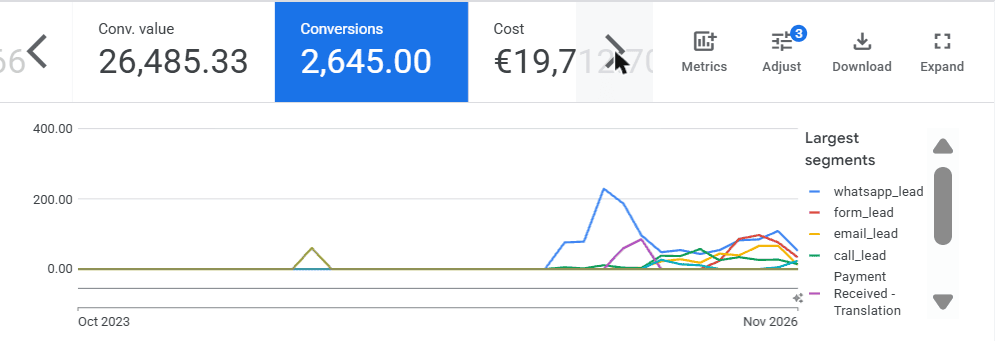
Over roughly 13 months the campaign spent €18,051 on 7,926 clicks and produced 2,188 enquiries. More than one in four clicks (27.6%) turned into an enquiry. 196 payments were matched back to ad clicks through the CRM import, which works out to about €92 of ad spend per paying customer traced.
| How people got in touch | Enquiries | Share |
|---|---|---|
| 1,191 | 54% | |
| Website form | 349 | 16% |
| Email click | 300 | 14% |
| Phone call | 283 | 13% |
| Online booking and other | 65 | 3% |
What I learned
- WhatsApp carried more than half of all enquiries. People with a document to translate want a quick quote. A form-only page would have lost most of them.
- Narrow intent beat broad reach. The click-through rate went from about 2% on the earlier general campaign to 13% once ads matched what people typed.
- Legal and notarized searches converted best. That ad group turned 31.9% of clicks into a conversion at €5.81 each, cheaper than the account average.
- Search volume is the ceiling. Google marks the campaign as limited by search volume, and cost per conversion drifted from €5.42 in Q1 2026 to €8.99 in Q4. Growth from here has to come from new language pairs and service lines, since raising the budget on the same searches would only raise the cost.
- Clean tracking came first. Counting each contact route once, and importing payments, is what made automated bidding safe to use.
Figures are from the Google Ads account and were not adjusted. “Enquiries” are WhatsApp clicks, form submissions, calls, email clicks and bookings recorded as conversions. Payments are those the CRM import could match to an ad click, so the true number of customers from ads may be higher.
If enquiries are what you need, see my lead generation service.
More Google Ads case studies
- Gardening and landscaping business, Perth
- UK broadband comparison site: a five-week search test
- Himachal tour operator: keyword data and a tracking mistake
- Healthcare app: App campaign conversions at ₹16.28
- Physiotherapy clinic, Delhi NCR: a call campaign that failed
- Nine small-budget Google Ads tests with real numbers
See all Google Ads case studies, or read the Google Ads guide for the basics behind these campaigns.