
Last Updated on by Amninder Singh
Industry: broadband and mobile deals comparison site · Market: United Kingdom · Channel: Google Search · Period: about five weeks from mid-October 2026 · Client name withheld
This is a test, and I am writing it up as one. The site earns when a visitor checks deals for their postcode and clicks through to a provider. The owner wanted to know whether Google Search could send those visitors at a workable cost. We ran three campaigns for about five weeks, measured the on-site actions, and then paused everything to review. Here is what the numbers showed.
The numbers at a glance
| Metric | Result |
|---|---|
| Ad spend | ₹72,422 (account billed in rupees) |
| Impressions | 27,935 |
| Clicks | 478 |
| Click-through rate | 1.71% |
| Average cost per click | ₹151.51 |
| Tracked on-site actions | 253 |
| Cost per tracked action | ₹286 |
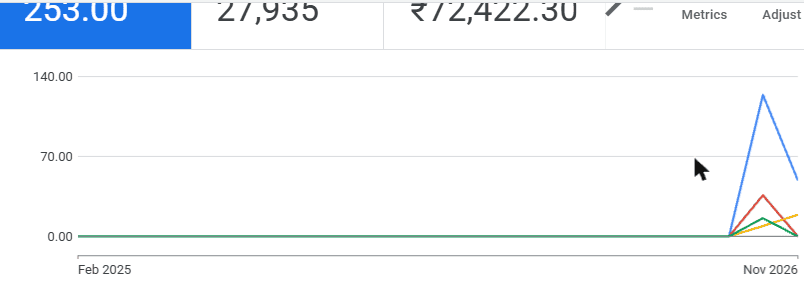
What we tracked, and what it means
None of the 253 tracked actions is a sale or a lead. They are steps a visitor takes on the site before leaving for a provider:
| Action | Count | What it is |
|---|---|---|
| Postcode check completed | 173 | Visitor entered a postcode and saw available deals |
| Go to provider site | 36 | Visitor clicked out to a provider from a broadband deal |
| Provider button click | 28 | Visitor clicked a specific provider’s button |
| Mobile “get deal” click | 16 | Visitor clicked out from a mobile deal |
One visitor can do two of these in a single visit. That is why one campaign shows more actions than clicks. I report them as actions, never as leads.
The three campaigns
| Campaign | Spend | Clicks | CTR | Avg. CPC | Actions | Cost per action |
|---|---|---|---|---|---|---|
| Customers of one large provider looking to switch | ₹55,618 | 283 | 1.13% | ₹197 | 99 | ₹562 |
| Generic broadband deals | ₹9,050 | 82 | 11.19% | ₹110 | 138 | ₹66 |
| Generic mobile deals | ₹7,755 | 113 | 5.34% | ₹69 | 16 | ₹485 |
What I learned
- The cheapest campaign got the least budget. Generic broadband deals produced actions at ₹66 each with an 11% click-through rate. The switcher campaign cost ₹562 per action and took 77% of the spend. If we run again, the split flips.
- Switcher keywords are expensive in the UK. Phrases such as “switch from [provider]” and “[provider] leaving fee” cost ₹400 to ₹1,700 a click. Volume was tiny: most of those keywords had fewer than ten clicks each.
- “How do I cancel” searchers did not shop. Exact-match cancel queries got clicks at ₹370 to ₹660 each and produced almost no postcode checks. Those people wanted cancellation steps. “Leaving fee” and “want to leave” queries did convert, because that searcher is weighing up a move.
- One broad keyword carried the switcher campaign. “[Provider] broadband deals” on broad match brought 66 clicks and 59 actions for ₹26,324. It worked, at ₹399 a click.
- Micro-conversions are a starting signal only. A postcode check shows interest. The site is paid on completed switches, and we had no data on those. Before spending more, the affiliate payout data has to be matched back to clicks so bidding can aim at paid switches.
What I would do next
- Move most of the budget to generic broadband deal searches.
- Keep only the switcher keywords that showed buying intent, and add the cancel queries as negatives.
- Import confirmed switches as the main conversion, with postcode checks as a secondary signal.
- Set a target cost per confirmed switch from the affiliate payout, and stop any keyword that cannot reach it.
Figures are from the Google Ads account and were not adjusted. No revenue or return is claimed because confirmed switches were not tracked during the test.